For many women, thinning hair is one of the most distressing changes to notice in the mirror — and one of the most misunderstood. Hair loss is often framed as a men’s issue, but it is remarkably common in women. According to the National Institutes of Health, more than 21 million women in the United States are affected by female pattern hair loss. If your part is widening or your ponytail feels thinner than it used to, you are far from alone — and you have real, non-surgical options. One of the most talked-about is platelet-rich plasma, or PRP.
Why Women’s Hair Loss Is Different
Women rarely go bald the way men do. Instead, female pattern hair loss (also called female androgenetic alopecia) usually shows up as diffuse thinning across the crown while the frontal hairline stays intact — a pattern dermatologists describe using the Ludwig scale. The NIH’s StatPearls resource notes that this type of hair loss affects roughly half of all people over a lifetime and becomes more common with age: studies cited by the NIH report incidences rising from about 12% in women around age 30 to 30–40% in women between 60 and 69.
Not all thinning is pattern hair loss, though. Another frequent cause in women is telogen effluvium — a temporary, often dramatic shedding that typically appears one to six months after a trigger such as childbirth, major stress, illness, surgery, rapid weight change, or a thyroid problem. The encouraging news is that telogen effluvium is usually reversible. Because the causes differ so much, the first step in any good treatment plan is figuring out what is actually driving your hair loss — which is exactly what a proper medical evaluation is for.
What Is PRP, Exactly?
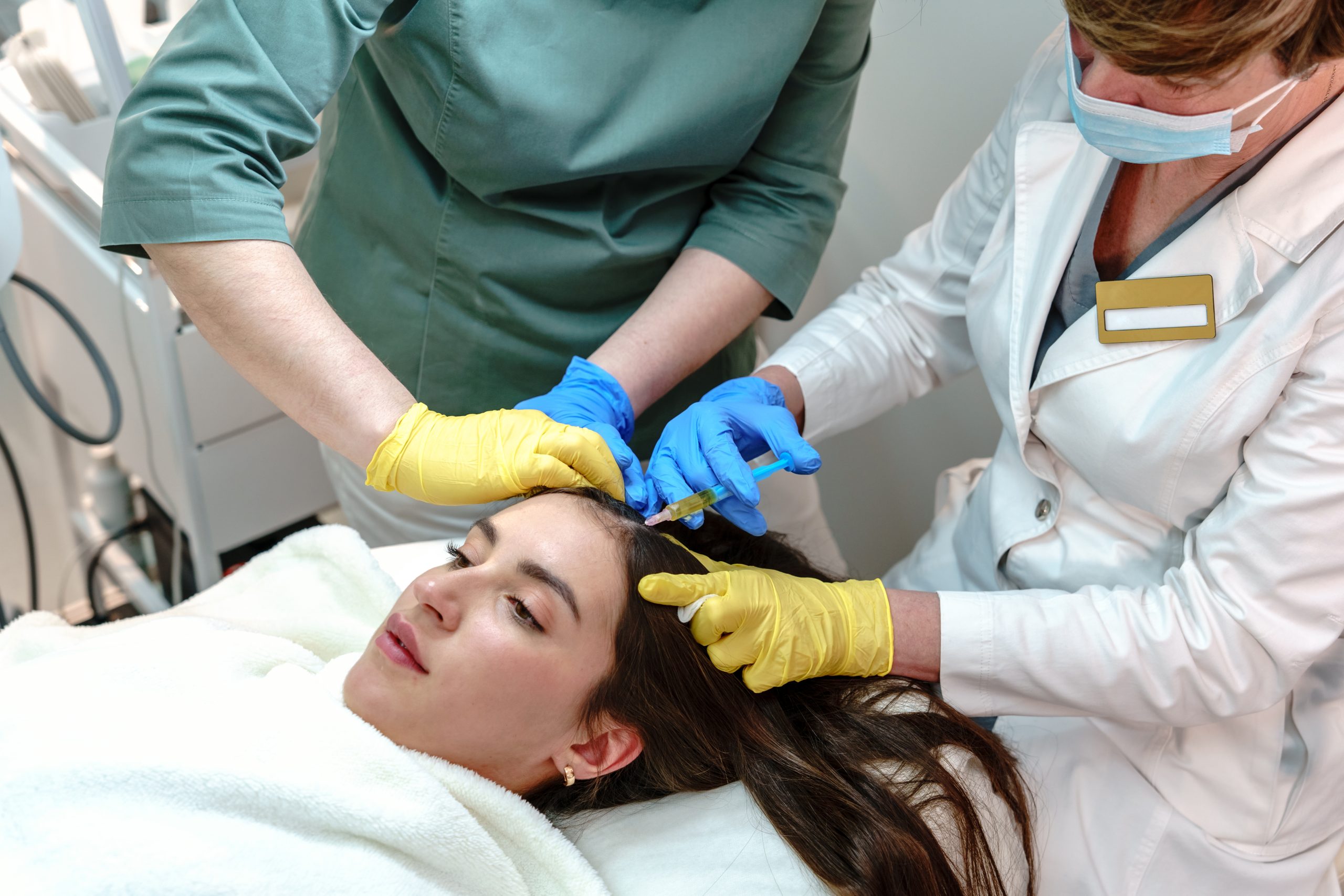
Platelet-rich plasma is a treatment made from your own blood. A small sample is drawn — similar to a routine blood test — and spun in a centrifuge to concentrate the platelets, the tiny cells packed with growth factors your body already uses to heal itself. That concentrated plasma is then injected into the areas of the scalp where hair is thinning.
The idea is simple: deliver a concentrated dose of your body’s own growth factors straight to struggling hair follicles, encouraging them to shift out of their resting phase and back into active growth. Because PRP comes entirely from you, there is no risk of allergic reaction or rejection, and no synthetic drugs are involved.
Does PRP Actually Work for Women?
PRP has become one of the most studied non-surgical hair treatments. A systematic review indexed by the National Library of Medicine found that in the majority of studies reviewed, patients receiving PRP therapy saw improvement, with increases in hair growth and thickness — and that combining PRP with minoxidil produced some of the highest improvement rates. Other clinical work on female pattern hair loss has reported visible new growth in women within roughly six weeks of starting a course of monthly sessions.
It is important to keep expectations realistic. PRP is not a cure, and it is not a hair transplant. It works best for early-to-moderate thinning where follicles are still alive but weakened — not for areas that are already completely bald. Results build gradually over months, and maintenance sessions are needed to sustain them. For the right candidate, though, PRP can meaningfully improve density and slow ongoing loss, all without surgery or downtime.

What to Expect From Treatment
Most PRP hair protocols follow a similar rhythm. An initial series of three to four sessions is typically spaced about four to six weeks apart, followed by maintenance treatments every six to twelve months to keep results going. Each session usually takes under an hour, and because the treatment uses a fine needle, most women describe the discomfort as mild and manageable.
There is essentially no downtime. You can return to your normal day afterward, with only minor, short-lived tenderness or redness at the injection sites. Many women notice reduced shedding first — often within the first couple of months — before new thickness becomes visible, which is why consistency and a little patience matter so much.
Who Is a Good Candidate?
PRP tends to work best for women in the earlier stages of thinning who still have functioning follicles to stimulate. You may be a strong candidate if you have noticed gradual thinning across the crown or a widening part, your hair loss is recent rather than decades-old, and you would prefer a natural, non-surgical approach.
Because hair loss in women can be tied to hormones, thyroid function, nutrition, or conditions such as polycystic ovary syndrome, a thorough evaluation matters. As the NIH notes, female pattern hair loss is sometimes linked to underlying health factors, so a good provider will want to understand the full picture before recommending a plan. PRP is also generally not recommended during pregnancy or for people with certain blood or clotting disorders — another reason a medical consultation comes first.
Getting Started With PRP
If you are exploring PRP for thinning hair, the most useful first step is a consultation with a provider who treats hair loss specifically in women. At PRP Treatment Clinic, our licensed team evaluates what is actually causing your hair loss before building a personalized plan. You can learn more about our PRP hair restoration treatment in Colleyville and our PRP hair restoration in Fort Worth, or explore the full PRP hair restoration program across our Texas locations.
Thinning hair can feel isolating, but it is common, it is well understood, and it is treatable. If you would like to find out whether PRP is right for you, contact our team to schedule a consultation and get answers tailored to your hair, your health, and your goals.
It helps to understand the hair-growth cycle. Every follicle moves through a growth phase (anagen), a brief transition, and a resting phase (telogen) before shedding. In pattern hair loss, follicles gradually spend less time growing and shrink with each cycle — a process called miniaturization, where hairs get finer and shorter until they stop producing visible hair. The growth factors in PRP are thought to nudge resting follicles back into the growth phase and support the tiny blood vessels that feed them, which is why treatment aims to catch follicles while they are weakened but still active.
Common Questions From Women Considering PRP
Is PRP safe for women? Because PRP is made from your own blood, it is considered very safe for most healthy women, with no risk of allergic reaction. The main side effects are minor and short-lived — mild tenderness, redness, or swelling at the scalp. It is generally avoided during pregnancy and in people with certain blood-clotting conditions, which a consultation will screen for.
How soon will I see results? Most women notice reduced shedding within the first one to two months, with visible improvements in thickness and density developing over three to six months as treated follicles cycle back into growth. Because hair grows slowly, before-and-after comparisons are usually most meaningful at the three- to six-month mark.
Can PRP be combined with other treatments? Yes. Many providers combine PRP with proven topical or oral therapies for hair loss, and research suggests that pairing PRP with minoxidil can improve results compared with either alone. Your provider can advise what combination, if any, fits your situation.
Does PRP work for all types of hair loss? PRP is most useful for pattern thinning and some cases of shedding where follicles are still viable. It is not a fix for scarring alopecia or areas that are completely bald, and it is not a replacement for a hair transplant in advanced cases. Identifying your specific type of hair loss first is what makes treatment effective.
Medical Disclaimer
This article is for general educational and informational purposes only and does not constitute medical advice, diagnosis, or treatment. It is not a substitute for a consultation with a licensed healthcare provider. Individual results from PRP vary and are not guaranteed. Any treatment should follow a personal evaluation by a qualified provider who has reviewed your medical history. Consult a healthcare professional before starting any treatment for hair loss.